
The Number Every Veteran Expects vs. The Number the VA Gives
Most veterans approach their disability ratings the same way they would approach any math problem: add the numbers together. A 50% rating for PTSD plus a 30% rating for a knee injury feels like it should equal 80%. A 70% rating plus a 30% rating feels like it should be 100%.
It does not work that way. The VA uses a method called the whole person theory, codified in federal law under 38 CFR § 4.25. Under this method, each additional disability rating is applied not to your original 100%, but to whatever percentage of you the VA still considers unaffected after the previous ratings have been applied.
The result is a combined rating that is almost always significantly lower than the sum of your individual ratings. The more conditions you have, the bigger the gap becomes.
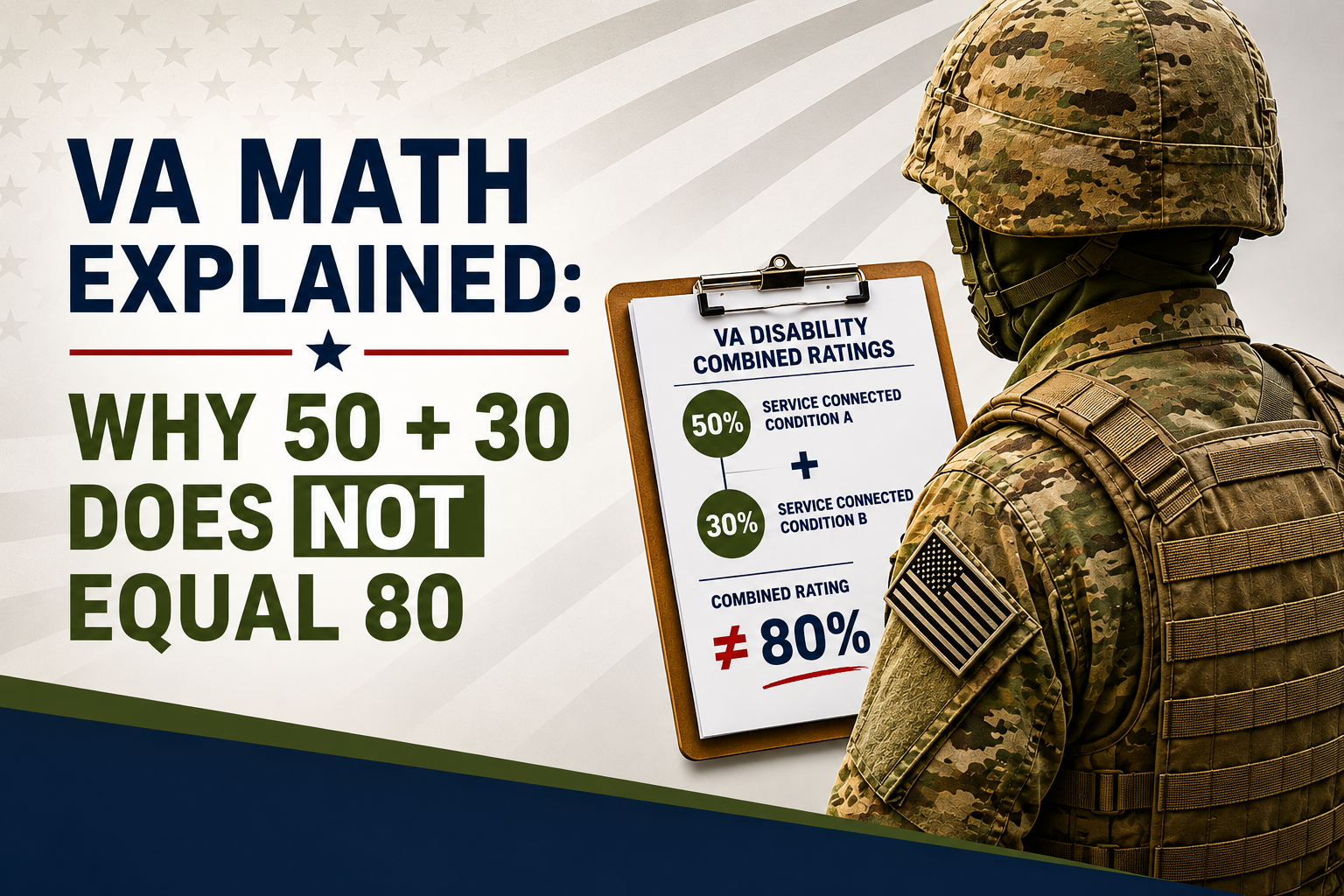
The short version: 50% + 30% = 65% under VA math, which rounds to 70%. Not 80%.
The Whole Person Method: How the Formula Actually Works
The VA starts with a simple premise: you, as a person, cannot be more than 100% disabled. Your body begins the calculation as a whole: 100% efficient, 0% disabled.
Your ratings are sorted from highest to lowest. The highest-rated condition is applied first. That rating is subtracted from 100%, leaving a remainder: the portion of you the VA still considers functional.
Every subsequent rating is then applied only to that remaining remainder. Not to the original 100%. To what is left after the previous rating was applied. Each new condition reduces what is already a smaller number, which is why combined ratings always increase more slowly than you expect.
The formula in plain terms
- Sort all ratings from highest to lowest.
- Start with 100% whole person efficiency.
- Subtract your highest rating; the remainder is your remaining efficiency.
- Multiply your next rating by the remaining efficiency and subtract that result from the remainder.
- Repeat the process for every remaining rating.
- Your combined disability is 100 minus your final remaining efficiency.
- Convert the final result to the nearest 10% rating tier.
Worked Example 1: Two Ratings, 50% and 30%
This is the most common scenario veterans ask about. Here is exactly how the VA combines a 50% rating with a 30% rating.
| Step | Calculation | Result |
|---|---|---|
| Step 1 | Start with 100% whole person efficiency. | Remaining: 100% |
| Step 2 | Apply highest rating first: 50% of 100 = 50 points of disability. | Remaining: 50% |
| Step 3 | Apply next rating to the remainder: 30% of 50 = 15 points of disability. | Remaining: 35% |
| Step 4 | Combined disability = 100 - 35. | Combined: 65% |
| Step 5 | Round 65% to the nearest 10%. | Official rating: 70% |
You expected 80%. The VA gives you 70%. That is VA math.
Worked Example 2: Three Ratings, 50%, 30%, and 10%
Adding a third rating does not add 10 percentage points to your combined rating. Because the 10% is now being applied to an already-reduced remainder, it contributes far less than its face value.
| Step | Calculation | Result |
|---|---|---|
| Step 1 | Start with 100% whole person efficiency. | Remaining: 100% |
| Step 2 | Apply 50%: 50% of 100 = 50 points of disability. | Remaining: 50% |
| Step 3 | Apply 30% to the remainder: 30% of 50 = 15 points of disability. | Remaining: 35% |
| Step 4 | Apply 10% to the remainder: 10% of 35 = 3.5 points of disability. | Remaining: 31.5% |
| Step 5 | Combined disability = 100 - 31.5. | Combined: 68.5% |
| Step 6 | Round 68.5% to the nearest 10%. | Official rating: 70% |
You expected 90%. Adding tinnitus at 10% moved your combined value from 65% to 68.5%, still rounding to 70%. The tinnitus added only 3.5 points of actual disability despite being rated at 10%.
Worked Example 3: Four Ratings, 70%, 30%, 20%, 10%
This example shows the diminishing returns effect clearly. By the time you reach a fourth rating, each additional condition contributes very little to your combined total, even if its individual rating is meaningful.
| Step | Calculation | Result |
|---|---|---|
| Step 1 | Start with 100% whole person efficiency. | Remaining: 100% |
| Step 2 | Apply 70%: 70% of 100 = 70. | Remaining: 30% |
| Step 3 | Apply 30% to 30: 30% of 30 = 9. | Remaining: 21% |
| Step 4 | Apply 20% to 21: 20% of 21 = 4.2. | Remaining: 16.8% |
| Step 5 | Apply 10% to 16.8: 10% of 16.8 = 1.68. | Remaining: 15.12% |
| Step 6 | Combined disability = 100 - 15.12. | Combined: 84.88% |
| Step 7 | Round 84.88% to the nearest 10%. | Official rating: 80% |
Four ratings total 130% individually. The combined result is 80%. This is why veterans with many conditions often feel their rating does not reflect the true extent of their disability.
VA Rounding Rules: When Your Rating Goes Up or Down
The VA converts your final combined value to the nearest 10% increment. The rules are straightforward, but the consequences at certain thresholds are enormous.
| Final Combined Value | VA Rounding Result |
|---|---|
| Ending in 1% to 4% | Rounds down to the lower 10% rating tier. |
| Ending in 5% to 9% | Rounds up to the higher 10% rating tier. |
| 94% | Rounds down to 90%. |
| 95% | Rounds up to 100%. |
The most important rounding threshold is the 94% to 95% line. A combined value of 94% rounds down to 90%. A combined value of 95% rounds up to 100%. That single percentage point difference is worth over $1,576 per month for a single veteran with no dependents under the 2026 pay table.
This is why knowing your exact combined value matters. Veterans sitting at 93% or 94% combined are very close to a threshold that can dramatically change monthly compensation, and adding even a small secondary condition may push them over.
What This Means for Your Claims Strategy
Understanding VA math is not just an academic exercise. It directly affects how you should approach filing claims, appealing decisions, and identifying conditions worth pursuing.
Lower-rated conditions matter more early on
When your combined rating is still low, such as 30% or 40%, each additional condition contributes more to your total because your remaining efficiency is still relatively high. A 20% condition added at this stage contributes meaningfully. The same 20% condition added when you are already at 80% combined contributes much less.
Secondary conditions are an efficient way to increase your rating
A secondary condition is one caused or aggravated by a condition you are already service-connected for. Sleep apnea caused by PTSD, knee problems caused by an altered gait from a back injury, and depression caused by chronic pain are common examples. These claims are filed under 38 CFR § 3.310 and can add meaningful percentage points without requiring a new direct service connection.
Know your combined value before you file
If your current combined rating is 64%, adding a 10% condition moves you to approximately 67.6%, still rounding to 70%. But if you are at 61%, adding that same 10% condition moves you to roughly 64.9%, which rounds to 60%, not 70%. Timing and order of claims can affect the rounding outcome.
Calculate Your Exact Combined Rating
You do not need to work through the formula by hand. Our free VA combined rating calculator applies the 38 CFR § 4.25 method to your ratings automatically, including the bilateral factor, and shows your combined value, official rounded rating, and estimated 2026 monthly pay.
Use the Free CalculatorFrequently Asked Questions About VA Math
Why don't VA disability ratings add up? +
The VA uses the whole person method defined in 38 CFR § 4.25. Each rating is applied to the remaining healthy percentage of your body, not the original 100%. This means every additional rating is worth progressively less, so your combined total is almost always lower than the sum of your individual ratings.
What is the VA whole person method? +
The whole person method treats your body as 100% at the start. Your highest rating is applied first, reducing what remains. Each subsequent rating is then applied only to what is left, not the original 100%. This prevents your combined rating from exceeding 100% through the formula alone.
What does 38 CFR 4.25 actually say? +
38 CFR § 4.25 is the federal regulation that governs how the VA calculates combined disability ratings. It establishes that ratings must be combined using the combined ratings table, applying each disability to the remaining efficiency of the veteran in order from most severe to least severe.
Does the VA round your combined rating? +
Yes. The VA rounds your final combined rating to the nearest 10%. A combined value ending in 1% to 4% rounds down. A combined value ending in 5% to 9% rounds up. Rounding happens only at the very end of the calculation, so 64% rounds to 60%, and 65% rounds to 70%.
Can you ever reach 100% through VA math? +
Yes, but it requires a very high combined value: 95% or higher for the final rating to round up to 100%. Because of the diminishing returns built into the formula, reaching 95% through multiple moderate ratings is difficult. Veterans who cannot reach 100% through ratings may qualify for TDIU, which can pay at the 100% rate even with a lower combined rating.
Legal reference: The combined rating formula described on this page is based on 38 CFR § 4.25 (Combined Ratings Table) and 38 CFR § 4.26 (Bilateral Factor). For official information, visit VA.gov.
Disclaimer: This page is for informational purposes only. It is not affiliated with the US Department of Veterans Affairs and does not constitute legal or medical advice. For personalized guidance, contact a VA-accredited VSO, attorney, or claims agent.